







Keep your steam radiators or tear them out? What an old Greater Boston house should do
Boiler dying or oil bills climbing? How to decide between a new steam boiler, hot water, ductless or air-to-water heat pumps, and what to ask first.
 Mateus Magno
Licensed Construction Supervisor · November 18, 2026 · 9 min read
The steam boiler is 40 years old, or the oil bill just made you sit down, and someone told you to rip out the radiators and go electric. Someone else said never touch steam. Homeowners across Greater Boston ask me which one is right.
My answer: it depends on how much heat your house loses, and that comes before the choice of equipment. Here is how I would work through it, what each option really involves and what to ask before you sign anything.
What is actually wrong with the system you have?
"Replace the boiler" is not a diagnosis. Write down which of these fits you:
- Noise and cold radiators. These are usually pitch, valves, vents or boiler water, not a dead system. My guide to why steam radiators bang and stay cold covers them, so I won't repeat it here.
- A failed or leaking boiler or pipe. That is a repair-or-replace decision.
- Big fuel bills. Check the house before blaming the boiler. Leaks at the attic floor and basement often matter more.
- You want air conditioning. Steam radiators can't cool, as MassLandlords points out in its piece on air-to-water heat pumps.
Heating pros disagree on this topic, and I'm a builder, not a steam specialist. In a February 2022 HeatingHelp thread about electrifying an old steam house, most replies favored keeping steam and cutting heat loss first. Other pros will tell you a well-done conversion is worth it.
What can a steam tune-up, vents, pipe insulation and a thermostat do?
Quite a lot, and none of it involves tearing anything out. These are the steps I'd ask a steam technician about:
- Insulate the steam supply pipes in the basement. HeatingHelp says bare steam pipes lose roughly five times as much heat as insulated ones, and that insulating them lets steam reach the radiators instead of condensing in the basement. See the asbestos warning below before anyone touches old wrap.
- Vent the mains properly. Fast, correctly sized main vents help steam reach all radiators at about the same time, per the same source. Have a pro size them.
- Have a licensed technician tune the burner and check the controls. In the HeatingHelp thread, one poster said combustion tuning could bring an old boiler's efficiency up to the low 80s percent. That is one person's estimate, not a promise.
- Be gentle with the thermostat. HeatingHelp's thermostat advice for steam warns against deep setbacks, because steam heats slowly and keeps releasing heat after the burner stops. It suggests about 5 degrees at most.
- Seal and insulate the house. See my air-sealing checklist and the Mass Save insulation rebates.
When does converting start to make sense?
These are the situations where I'd seriously price a change:
- The boiler has failed. Cracked sections or a worn-out boiler on a system you were already tired of.
- Pipes keep leaking. Especially return lines that are hidden or buried. Ask a steam tech whether these "wet returns" can be repaired or whether the problem will keep coming back.
- You want cooling. A ductless heat pump or an air-to-water system with cooling covers what steam can't.
- You want separate zones. Steam is basically one zone per boiler. Hot water or a heat pump can give each floor its own thermostat.
- You are already renovating. With walls open, piping and wiring are easier to change.
What are your options, and what does each really involve?
| Option | What stays | What changes | Watch for |
|---|---|---|---|
| New, right-sized steam boiler | Pipes and radiators | The boiler, controls, near-boiler piping | Oversized boilers from decades ago. Size it to the house as it is now |
| Steam to hot water boiler | Radiators, maybe some piping | New supply and return loop, circulator, relief valve and controls | One-pipe systems usually need new return piping. Radiators must be pressure tested |
| Ductless heat pump | Often the old boiler, as backup | Wall or ceiling units, outdoor unit, electrical work | Radiators are often removed. Back rooms may run cooler |
| Air-to-water heat pump | Radiators, if they can heat at lower water temperature | Outdoor unit, hot water piping, controls | Radiators sized for hot steam may fall short at low water temperature |
| Hybrid: heat pump plus old boiler | Both | Added heat pump, controls | Mass Save has rules for keeping old heat alongside. Ask your installer |
Steam to hot water. The Boilers On Demand guide says cast-iron steam radiators can't just be piped in series, so you need a new loop with larger piping. It describes pressure testing the system to 30 PSI, having a licensed pro swap the 15 PSI steam relief valve for a 30 PSI one (never a DIY change), and warns that steam boilers run at about 0.5 to 5 PSI, so leaks in old sections may not show up on steam. It also says converting a steam system to hot water reduces its capacity by 10% or more. Heating pros on the HeatingHelp forum often say the same: one-pipe is the hard case.
Heat pumps and radiators. The Boston Globe's Ask the Remodeler column said on October 16, 2026 that with a heat pump's wall or ceiling units you will likely want to remove old radiators and baseboards, and that is an added expense, including patching. An air-to-water heat pump is meant to keep the radiators. MassLandlords says old hot water systems were designed for roughly 180°F water, and that radiators can work at lower temperatures only if they are sized for it. A HeatingHelp poster estimated that radiators on 180°F water put out about two-thirds of what they do on steam. Mass Save's air-to-water page says the systems deliver heat through water piped through the home. It doesn't explain how they connect to existing radiators, so ask a Mass Save installer for your specific house.
What should a heat-load calculation include?
Every path above depends on one number: how much heat your house loses on a design-cold day. Insist on a written Manual J calculation before you accept any equipment quote. The Building America Solution Center, a U.S. Department of Energy program hosted by PNNL, says in its cold-climate heat pump guide to use Manual J rather than rules of thumb and calls room-by-room calculations a best practice. Ask for:
- Room-by-room results, not a single square-foot guess.
- The inputs. Wall and attic insulation, window types and how leaky the house is. A blower door test is the most accurate measure of leakage, per the same guide.
- Output at the design temperature, not the nameplate. Heat pump output drops in the cold, so ask for the manufacturer's data at your design temperature.
- For radiators, each radiator's output at the water temperature the new system will run. For example, if a room needs 12,000 BTU and the radiator gives 7,000 at that water temperature, you have an answer before you buy.
- A copy of the report. Mass Save's air source heat pump page offers a $500 sizing bonus to partial-home customers, but only for systems sized to 90 to 120 percent of the home's heating load per Manual J, with the calculation submitted.
Do the air sealing and insulation first, then the calculation. A tighter house needs smaller, cheaper equipment. My Home Energy Upgrade Guide walks through that order for an old house.
Does the Mass Save change on January 1 affect your timing?
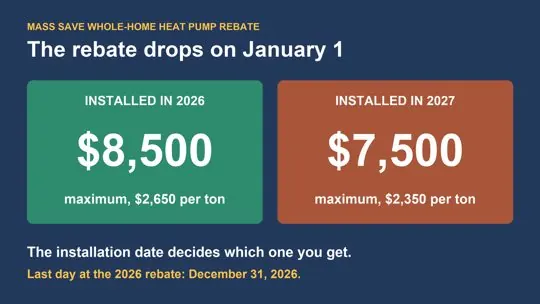
It might. As of November 18, 2026, Mass Save's pages show this. For installs on or after January 1, 2027, the whole-home rebate drops from $2,650 per ton (up to $8,500) to $2,350 per ton (up to $7,500). Air-to-water systems list the same amounts. The partial-home rebate falls from $1,125 to $1,000 per ton, with the cap going from $8,500 to $7,500. The installer must be in Mass Save's Heat Pump Installer Network, so ask any contractor about that up front.
In an old house, whole-home also needs the house to be sufficiently weatherized, such as an assessment recommending under $1,000 of work. The install date counts, not the contract date. I go through who should hurry in the January rebate post.
My view: the gap is at most $1,000 on a whole-home system, which is not worth a badly sized design. If you haven't had the assessment and heat-load calculation, you probably can't finish well before December 31. Price it at the 2027 amount, and don't rush.
What about running costs, gas versus electric?
I can't tell you what your bill will do, because it depends on your house, fuel and rate. What I can point to:
- Gas delivery and supply rates are changing. See what changed on November 1 and what could change in January.
- Heat pump owners may qualify for a seasonal electric rate from November 1 through April 30. Here's how to check you're on it.
- If you heat with oil, start with the oil-price plan.
For equipment cost context, the Globe reported a boiler replacement at about $12,000 to $15,000 in Massachusetts for a roughly 97% efficient unit, and a whole-home heat pump at up to $50,000 depending on house size (October 16, 2026). Those are the Globe's figures, not quotes. A 97% unit is almost certainly a condensing hot water boiler, so don't assume that range applies to a steam boiler. See my boiler replacement guide and heat pump cost guide for more.
Heat pumps also add electrical load. The Globe notes some homes need a service upgrade, so look at panel upgrade costs early.
Who does what, and where is the safety line?
| Task | Who |
|---|---|
| Boiler replacement, gas piping, venting | Licensed plumber or gas fitter with the permit |
| Oil burner work | Certified oil burner technician |
| Steam balancing, main vents, pressure controls | Experienced steam technician |
| Heat pump install | HVAC contractor (Mass Save network for rebates), licensed electrician for the wiring |
| Testing old pipe or boiler wrap | Licensed asbestos inspector |
| Air sealing, insulation, patching after radiators come out | Insulation contractor, or a builder like me |
A few hard lines. Never cap, plug or adjust a boiler's relief valve, and don't bypass the low-water cutoff. If a boiler discharges steam or hot water, switch it off and call a pro. Test your carbon monoxide alarms (my smoke and CO alarm guide covers placement). If one sounds, get everyone outside and call 911.
Asbestos. White or gray wrap on old pipes and boilers can be asbestos. HeatingHelp says to leave it alone. Massachusetts asbestos rules, 310 CMR 7.15, treat suspect pipe and boiler insulation as something a licensed asbestos inspector surveys before renovation work. The state rule only exempts an owner of an owner-occupied single-family home who is abating non-friable material, and old pipe wrap is often friable, so my advice is simple: test first, plan the boiler job around the result, and let licensed abatement handle anything that must come off.
Want help sorting out the order?
I'm Mateus, a licensed builder in Davis Square. Since 2020 I have renovated and managed over $5 million in projects around Somerville and Greater Boston. I'm not a heating contractor, but I can look at the whole house, help you get the air sealing and assessment done first and line up licensed trades. Book a free walkthrough and we'll look at it together.
Frequently asked questions
Should I keep my steam heat or convert to hot water?
It depends on the condition of the boiler and pipes, how much heat the house loses and whether you want cooling or zoning. Heating pros disagree. Many favor a right-sized new steam boiler if the pipes and radiators are sound, while conversion makes more sense after a failure or alongside a bigger renovation. Get a heat-loss calculation and more than one opinion.
Can I convert a one-pipe steam system to hot water?
It is the harder case. A conversion guide I read says steam radiators need a new supply and return loop with larger piping, and the system should be pressure tested to 30 PSI. HeatingHelp posters say one-pipe systems usually need new return piping and the radiators may not work well. A licensed heating contractor should review it.
Can a heat pump heat my house with the old radiators?
Sometimes. An air-to-water heat pump can feed radiators, but old radiators were sized for hotter water. Ask for each radiator's output at the lower water temperature, checked against a room-by-room heat-loss calculation. Wall or ductless units usually mean removing the radiators, as the Boston Globe reported.
What is a Manual J, and why ask for it?
It is the standard heat-loss calculation for a home. The Building America Solution Center, a U.S. Department of Energy program, advises using it instead of rules of thumb and doing it room by room. It also lets you compare quotes fairly.
Does the Mass Save heat pump rebate change on January 1, 2027?
Yes. As of November 18, 2026, Mass Save lists the whole-home rebate dropping from $2,650 per ton (up to $8,500) to $2,350 per ton (up to $7,500) for installs on or after January 1, 2027, with the partial-home rebate falling from $1,125 to $1,000 per ton. The install date counts, and whole-home requires the house to be sufficiently weatherized.
Is the white wrap on my steam pipes asbestos?
It might be. You can't tell by looking. Don't touch, cut or sand it. In Massachusetts, suspect pipe and boiler insulation is surveyed by a licensed asbestos inspector before work that would disturb it, and licensed professionals handle removal. Plan any boiler replacement around the test result.
See everything I do, how I price work and the towns I work in.
Read this next
 Home Care & SafetyWhy old steam radiators bang, hiss and stay cold: the checks to make before you call a proClanging pipes, a radiator that never warms, a hissing vent. What causes each one in an old Greater Boston house, and what is safe to check yourself.9 min read · Keep reading →
 Costs & BudgetsBoiler replacement cost in Massachusetts: oil, gas or heat pump in 2026?Boiler replacement cost in Massachusetts for 2026: no Mass Save rebates for most gas or oil boilers, heat pump options, and permits for Somerville homes.4 min read · Keep reading →
 Costs & BudgetsMass Save's heat pump rebate drops on January 1. Should you hurry?Mass Save's whole-home heat pump rebate falls from $8,500 to $7,500 for installs on or after January 1, 2027. What you'd lose and who should hurry.4 min read · Keep reading →
 Home Care & SafetyDo heat pumps really work in a Somerville winter? A builder's honest answerDo heat pumps keep a Somerville home warm in January? Cold-climate specs, weatherization, triple-decker layouts, wiring, and 2026 Mass Save rebates.4 min read · Keep reading →
 Costs & BudgetsHeating oil is about $6 a gallon. What an old house can do before the next fill-upA standard tank fill has been reported at over $1,500. Here are five moves for an oil-heated old house, in order, plus the help that exists and what not to rush.8 min read · Keep reading →
 Home Care & SafetyHow to winterize a drafty house: an air-sealing and insulation checklist for Somerville, Cambridge and Greater BostonCold rooms and high heating bills? Find where a Greater Boston house really leaks (attic, basement, windows, outlets) and fix it before winter, step by step.3 min read · Keep reading →
Mateus Magno founded Magno & Co in 2020. He is a licensed Massachusetts Construction Supervisor (CS-123658), registered Home Improvement Contractor (HIC #220484) and certified Lead-Safe Renovator Supervisor who has renovated and managed over $5 million in projects across Greater Boston.
More about Mateus →