









The heat pump winter rate started Nov. 1: how to tell if you are getting it
Heat pump owners in Greater Boston fear a big winter electric bill. Here is how to read your bill, check your rate and see what really drives the kWh.
 Mateus Magno
Licensed Construction Supervisor · November 18, 2026 · 8 min read
I get this question from homeowners all over Greater Boston right now: "I switched to a heat pump. Is my winter electric bill about to blow up?" The honest answer depends on two things you can check this week: which rate you are actually on, and how many kWh your house burns to stay warm.
Below is how I would read the bill, confirm the heat pump rate, and find the real drivers of a winter bill. I'm a builder, not a utility or a rate analyst, so I'll point you to the official sources for every number.
Why is everyone suddenly worried about the winter electric bill?
Two things landed close together. On August 1, 2026, Eversource's basic service supply rate rose from 15.6 to 17.3 cents per kWh, according to Boston.com's July 29 report. Then November 1 started the winter season for the state's seasonal heat pump rate.
People are also reading stories like the one Boston.com ran on October 29, where one homeowner reported a $256 electric bill against $86 a year earlier, with a heat pump water heater and EV charging in the mix and a gas bill that nearly disappeared. That is one household, not a forecast for yours. But it shows the pattern: electric goes up, gas or oil goes down, and what matters is the total.
If you want the gas side of that picture, I covered it in Massachusetts winter gas bills in 2026.
Which rate are you on for the supply part of the bill?
Your Eversource bill has two halves. Delivery is the wires and poles, and Eversource sets it. Supply is the electricity itself, and who sets it depends on you. According to the Boston.com report, which cites state data from March 2026, about 26.6% of customers were on basic service, about 51% were in a municipal aggregation program, and about 22% had chosen a competitive supplier.
| Supply type | Who sets the price | How to spot it |
|---|---|---|
| Basic service | Eversource, reset about every six months | Supply section names Eversource Basic Service |
| Municipal aggregation | Your city or town, through a contract with a supplier | Supplier name plus a town program name |
| Competitive supplier | A company you (or someone) signed up with | A supplier name you may not recognize, often with a contract end date |
In Somerville, the city runs Community Choice Electricity. Per the city's rates page, its three products are priced at 13.220, 14.840 and 16.060 cents per kWh for the supply portion, and the term runs from December 2024 through January 2028. The city notes it cannot guarantee savings against Eversource basic service. Other towns have their own programs, so check yours.
Before you switch to a competitive supplier on your own, use the state's Energy Switch site and read the contract end date and what happens after it. Boston.com reports that state officials have flagged complaints about some individual suppliers since 2018.
What is the heat pump rate, and who gets it?
Massachusetts required its big electric utilities to offer a seasonal rate for homes heated with heat pumps. Per Eversource's heat pump rate page, which I read on November 18, 2026:
- It runs November 1 through April 30. From May through October you pay the standard residential rate.
- It lowers the distribution and transmission charges per kWh. That is the delivery side of the bill, not supply.
- You can have it even if your supply comes from a municipal program or a third-party supplier.
- Homes heated with electric resistance, such as baseboards, space heaters or electric furnaces, do not qualify.
- Customers who got a Mass Save heat pump rebate through their Eversource account on an install after January 1, 2019 are enrolled automatically. Everyone else applies.
How much does it help? Eversource says enrolled customers paid about $430 less last winter, roughly $72 a month. WBUR reported in April that about 140,000 households had enrolled and that the state projected an average first-winter saving of $540. Those are averages from different sources. Your number depends on your house.
One thing I could not confirm: the exact cents-per-kWh values of this winter's heat pump rate. Look at your own bill or Eversource's tariff for those.
How do you check you are getting it? A 15-minute check
| Step | What to do | What you are looking for |
|---|---|---|
| 1 | Open your latest Eversource bill (PDF or app) | Rate name on the delivery side. Look for the words heat pump. If you only see a code, ask Eversource what it means |
| 2 | Compare a November bill line to an October one | Delivery cents per kWh should look different after November 1 |
| 3 | If you are not on it, check the Eversource heat pump rate page | Whether your install qualifies, and the list of accepted documents |
| 4 | Gather proof | Equipment receipt, contractor invoice, Mass Save rebate confirmation, or a photo of the outdoor unit's model and serial plate |
| 5 | Apply online or call | Eversource lists a free virtual heat pump identification consultation for eligibility questions |
| 6 | Note the date you applied | Ask whether the discount applies from the date you were enrolled, so you know what to expect on the next bill |
One more tip: if the bill only shows a combined delivery number, call Eversource and ask which delivery rate is on your account. A plain question gets a plain answer.
What really drives the kWh in winter, and does ductless or ducted matter?
The rate sets the price per kWh. The house decides how many kWh you use. For a heat pump, four things matter most:
- Sizing. An undersized system runs flat out in a cold snap and may lean on backup heat. An oversized one can cycle on and off. A good installer sizes from a heat-loss calculation, not from square footage alone.
- The envelope. Drafts and thin insulation raise the load the heat pump has to cover. This is the biggest lever on an old house.
- Layout. Where the heat is delivered matters, as I explain below.
- Backup resistance heat. Electric strips or baseboards inside a system can use a lot of power. Ask what triggers them.
My Home Energy Upgrade Guide covers the upgrades that make an older Massachusetts home use less energy, including air sealing, insulation and heating.
Does ductless versus ducted change the winter bill? Not by itself, but layout changes how well the heat reaches people. A ductless mini-split in the living room can leave a back bedroom cold, and then someone plugs in a space heater. That is resistance heat, the most expensive way to make heat from electricity, and it also falls outside the rate's eligibility.
Ducted or multi-head systems that reach every room reduce that temptation. In an old triple-decker, I often see one unit asked to heat a floor with closed doors and a long hallway. If that sounds like your place, read how heat pumps behave in a Somerville winter and what installs cost.
Also check the panel. Adding a heat pump or a heat pump water heater can push an old service to its limit, and that is licensed electrician work. See what a panel upgrade costs and the heat pump water heater guide.
Why does air sealing beat rate shopping?
Rate shopping changes the price of each kWh a little. Air sealing and insulation change how many kWh you need all winter. Here is a simple illustration with round numbers. It is not a forecast and not a quote.
| Lever | What changes | Round-number example |
|---|---|---|
| Pick a cheaper supply product | The supply price per kWh | A 4-cent difference on 1,000 kWh is about $40 a month |
| Use fewer kWh | Every kWh, on delivery and supply | If your all-in cost is near 34 cents (the figure in the Boston.com October story), 150 fewer kWh is about $51 a month |
| Both | Price and quantity | They stack, but the house change lasts for years and the supply price resets |
Supply prices also move. Basic service resets about every six months, so a bargain can become an average one by spring. A tight attic floor and sealed rim joists keep working. Start with the drafty house air sealing checklist, then see attic insulation R-values, dense-pack walls and the Mass Save insulation rebates. Mass Save's offers change, so confirm the current terms with them.
What about the January 1 rebate change?
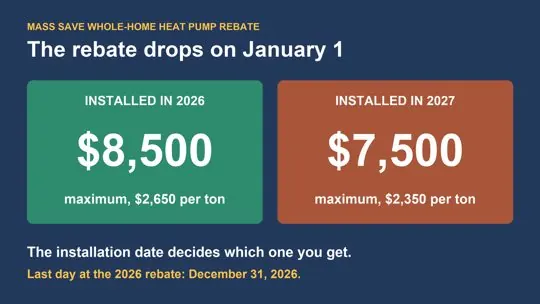
If you are still deciding whether to install, one date matters. Mass Save's heat pump rebate for whole-home systems drops on January 1, 2027, from $2,650 per ton (up to $8,500) to $2,350 per ton (up to $7,500). The amount depends on the installation date, so equipment has to be in by December 31, 2026 for the 2026 rebate. My post on the rebate change has the paperwork deadline and the weatherization rule.
There is a bill link here too. Eversource enrolls customers automatically when a heat pump got a qualifying Mass Save rebate through their account, which makes the paperwork trail cleaner. A rushed install is not a good one, though. Do not let a deadline pick your contractor or your system size.
What should you do this week?
- Find out whether your supply is basic service, your town's program or a supplier, and write down the price and the end date.
- Confirm the heat pump rate on the delivery side of your bill. If it is missing, gather your proof and apply.
- Read your kWh history for the last two winters. Usage tells you more than the dollar total.
- Ask your installer what triggers backup resistance heat in your system.
- Seal the leaks you can reach, and get the attic and rim joists assessed before the deep cold.
Want a second set of eyes on your house?
If your winter bill looks wrong, or you are planning air sealing, insulation or a heat pump install, I'm happy to walk through the house and tell you what I see. I'm a licensed Massachusetts contractor in Davis Square, and the walkthrough is free. Get in touch here. I can't read your meter or your account, but I can tell you where the heat is leaving the house.
Frequently asked questions
How do I know if I'm on the Eversource heat pump rate?
Look at the delivery side of your Eversource bill for a heat pump rate name. Eversource says customers whose Mass Save heat pump rebate went through their Eversource account on an install after January 1, 2019 are enrolled automatically and notified. If you do not see it, check eligibility on Eversource's heat pump rate page or call them.
When does the seasonal heat pump rate apply?
From November 1 through April 30. Per Eversource, from May through October heat pump customers pay the standard residential rate.
Do I have to apply for the heat pump rate?
Not if you were auto-enrolled through a qualifying Mass Save rebate. Others can apply with a document such as an equipment receipt, contractor invoice, Mass Save rebate confirmation or a photo of the outdoor unit's model and serial plate.
Does the heat pump rate work if my supply comes from my town's program or a supplier?
Per Eversource's page, yes. Municipal aggregation and third-party supplier customers can participate. The discount is on the delivery side, which is separate from supply.
Will a heat pump raise my electric bill this winter?
Usually the electric bill rises while gas or oil spending falls, so look at the total. Sizing, air leaks, insulation and backup resistance heat all affect how many kWh you use. Averages from the sources I read were $430 (Eversource, last winter) and $540 (state projection), but your house may differ.
Are homes with electric baseboard heat eligible?
No. Eversource says homes that heat with electric resistance, such as baseboards, space heaters or electric furnaces, do not qualify. The rate is for heat pump heating.
See everything I do, how I price work and the towns I work in.
Read this next
 Home Care & SafetyDo heat pumps really work in a Somerville winter? A builder's honest answerDo heat pumps keep a Somerville home warm in January? Cold-climate specs, weatherization, triple-decker layouts, wiring, and 2026 Mass Save rebates.4 min read · Keep reading →
 Costs & BudgetsMass Save's heat pump rebate drops on January 1. Should you hurry?Mass Save's whole-home heat pump rebate falls from $8,500 to $7,500 for installs on or after January 1, 2027. What you'd lose and who should hurry.4 min read · Keep reading →
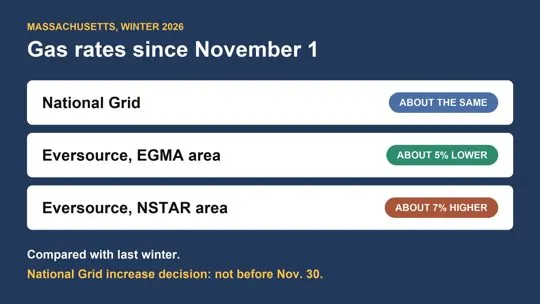 Home Care & SafetyMassachusetts winter gas bills: what changed November 1, what could change January 1 and what to fix firstWinter gas rates started Nov. 1 in Massachusetts. What changed for National Grid and Eversource, the January increase on the table and what to fix first.4 min read · Keep reading →
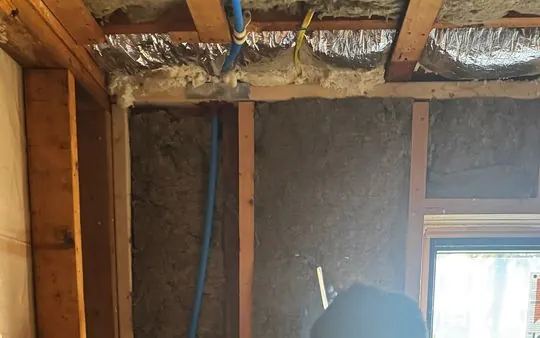 Home Care & SafetyHow to winterize a drafty house: an air-sealing and insulation checklist for Somerville, Cambridge and Greater BostonCold rooms and high heating bills? Find where a Greater Boston house really leaks (attic, basement, windows, outlets) and fix it before winter, step by step.3 min read · Keep reading →
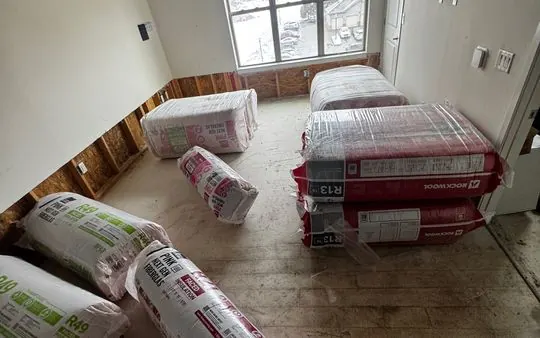 Costs & BudgetsMass Save insulation rebates in 2026: 75–100% off, no-cost options and the steps for Somerville, Cambridge and Greater BostonMass Save insulation in 2026: how the 75–100% off and no-cost offers work, what's covered, the federal credit that ended, and the steps to get started.3 min read · Keep reading →
 Costs & BudgetsHeat pump installation cost in Massachusetts: 2026 rebates, rates and old-house realitiesHeat pump installation cost in Massachusetts for 2026: Mass Save rebates up to $8,500, winter electric rates, and what drives price in Somerville homes.5 min read · Keep reading →
Mateus Magno founded Magno & Co in 2020. He is a licensed Massachusetts Construction Supervisor (CS-123658), registered Home Improvement Contractor (HIC #220484) and certified Lead-Safe Renovator Supervisor who has renovated and managed over $5 million in projects across Greater Boston.
More about Mateus →