












Massachusetts winter gas bills: what changed November 1, what could change January 1 and what to fix first
Winter gas rates started Nov. 1 in Massachusetts. What changed for National Grid and Eversource, the January increase on the table and what to fix first.
 Mateus Magno
Licensed Construction Supervisor · November 4, 2026 · 4 min read
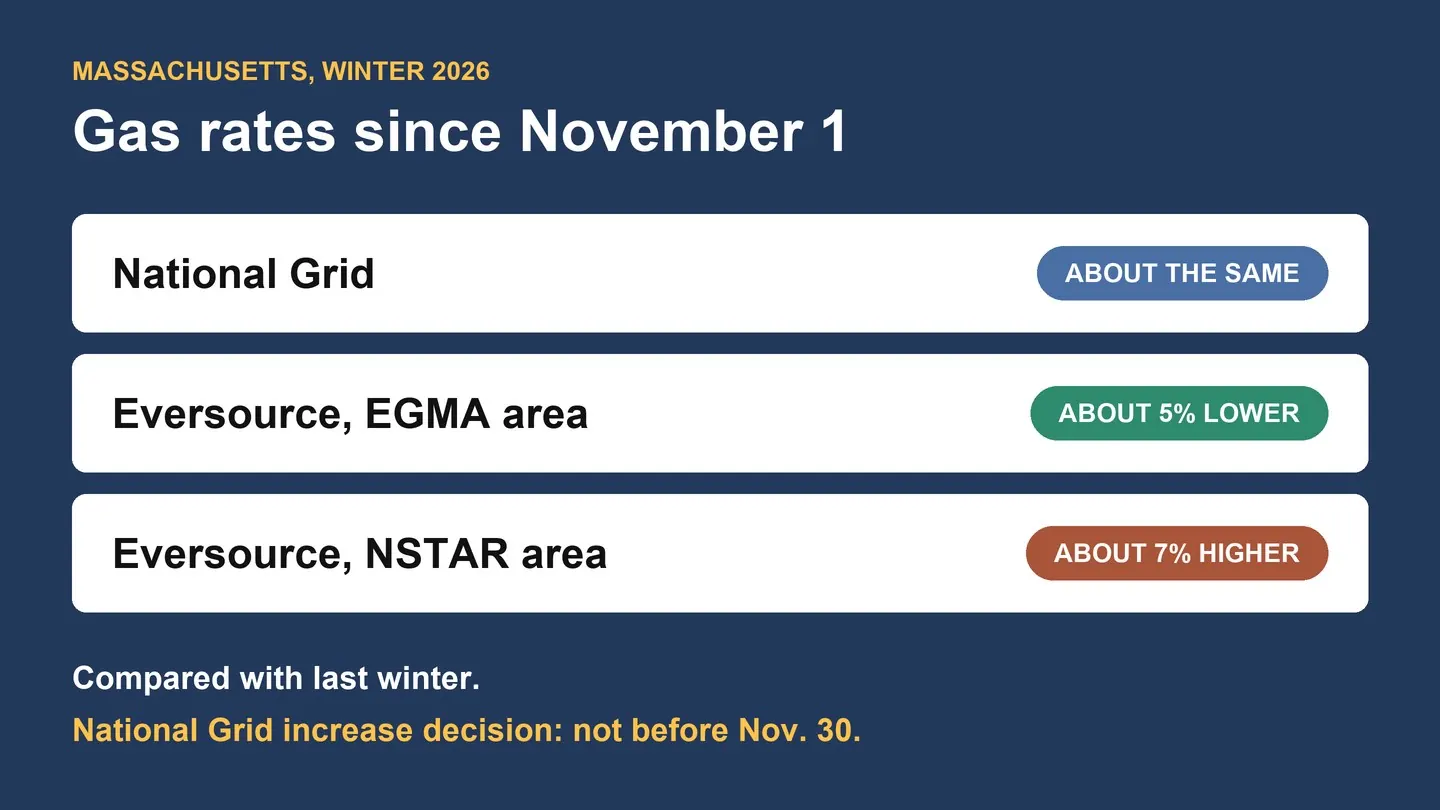
Massachusetts winter gas rates took effect November 1. National Grid customers pay about the same as last winter, Eversource customers in the former Columbia Gas area get about 5% off, and Eversource NSTAR customers pay about 7% more. Every customer gets a bill credit of at least $20 in January and in February. Separately, National Grid has asked for a $342 million increase starting January 1, and regulators won't decide before November 30.
Gas heating bills are the first thing people bring up when I walk through an older house in November. This year the news is mixed, and it depends on whose name is on your bill.
Here's what regulators approved, what's still pending as of November 4, 2026 and where I'd spend money if you want a smaller bill.
What changed on November 1?
The state Department of Public Utilities approved these winter rates, the Boston Globe reported. Check the company name on your bill to find your row.
| Your gas company | Compared with last winter | Bill credits |
|---|---|---|
| National Grid | About the same | At least $20 in January and February |
| Eversource, EGMA area (former Columbia Gas) | About 5% lower | At least $20 in January and February |
| Eversource, NSTAR area | About 7% higher | $30 in January and February, $25 in March |
Eversource attributed the NSTAR increase to infrastructure costs deferred from last winter.
Why are bills still high if gas is cheap?
Your bill has two main parts: the gas itself, and the delivery charge for the pipes and everything that goes with them. The Globe reports the gas itself is at its lowest price in years. Delivery is charged separately, so a cheap commodity doesn't always mean a cheap bill.
What could change on January 1?
National Grid has asked regulators for a $342 million increase to pay for pipe and system upgrades. It's the company's first request since 2021. Reports put the bill impact at up to nearly 11% if it's approved in full.
In April, National Grid's own estimate for a typical home heating customer looked like this:
- Boston Gas area: about $23.66 more per winter month, or 8.4%.
- Colonial Gas area: about $25 more per winter month, or 9.4%.
Those are the company's numbers for what it requested, so regulators could approve less. The start date reported then was December 1, and current reports say January 1. The decision won't come before November 30.
What should you fix first to lower a gas bill?
You can't control the rate, but you can control how much gas your house burns. In the older houses I work on around Somerville and Cambridge, this is the order I'd use:
- Get a Mass Save Home Energy Assessment. It's no cost, and it includes a blower-door test that finds your leaks. It's also the door to the insulation rebates.
- Seal the attic floor and the basement rim joist. Those usually leak more than the windows. Here's my air-sealing checklist.
- Add attic insulation after the sealing is done. The target is R-49 to R-60, and many old attics have a fraction of that.
- Service the boiler or furnace. If it's near the end of its life, read what a boiler replacement involves before it fails in January.
- Replace windows later, if at all. They're often the most expensive fix and rarely the biggest leak.
Should you switch to a heat pump before the rebate drops?
Only if it already makes sense for your house. Mass Save's whole-home rebate is $2,650 per ton, up to $8,500, for systems installed by December 31, 2026. From January 1, 2027, it's $2,350 per ton, up to $7,500.
That gap can be up to $1,000. It's not worth a rushed design or a poorly sized system. Whole-home rebates also have a weatherization requirement, so an older house may have work to do first. Whether you'd save on running costs depends on your house and your gas and electric rates, so I won't promise a number. Start with what heat pumps cost here and how they handle winter.
What if you can't pay your gas bill?
- Winter shutoff protection. From November 15 through March 15, a utility can't shut off heat for a household that can't pay and meets the income guidelines. You call the company and sign a financial hardship form within seven days. The bills keep adding up, so this delays the problem without erasing it.
- Fuel assistance. The Home Energy Assistance Program for Somerville and Cambridge takes applications from renters and homeowners through April 30. The City lists a limit of $53,585 for a one-person household. Call 617-665-6234.
- If your income is over that limit. The City's page points to the Massachusetts Good Neighbor Energy Fund at 1-800-334-3047.
Somerville owners can also look at rebates, grants and 0% loans for bigger energy work.
What to watch next
- The DPU's decision on National Grid, no earlier than November 30.
- The state energy bill. The House and Senate each passed a version this year, and I couldn't confirm a final bill as of November 4.
- December 31, the last day to install a heat pump at the 2026 rebate.
Want a warmer house this winter?
I'm Mateus, a licensed builder based in Davis Square, and I work in Somerville and across Greater Boston. Book a free walkthrough and you'll get a written line-item budget, usually within 48 hours.
Frequently asked questions
Are Massachusetts gas bills going up this winter?
It depends on your company. Winter rates from November 1 are about the same as last winter for National Grid, about 5% lower for Eversource's former Columbia Gas area and about 7% higher for Eversource NSTAR. National Grid has also asked for a separate increase starting January 1.
How much could National Grid gas bills go up in January?
Reports put it at up to nearly 11% if the $342 million request is approved in full. In April, National Grid estimated about $23.66 more per winter month for a typical heating customer in its Boston Gas area. Regulators won't decide before November 30, 2026.
What gas bill credits are customers getting this winter?
All gas customers get a credit of at least $20 in January and February. Eversource NSTAR customers get $30 in January and February and $25 in March.
Can my heat be shut off in winter in Massachusetts?
A household that can't pay and meets the income guidelines is protected from heat shutoff from November 15 through March 15. You have to contact the utility and sign a financial hardship form. Unpaid bills keep adding up during that time.
What's the best way to lower a gas heating bill in an old house?
Start with a no-cost Mass Save Home Energy Assessment, then seal the attic floor and basement rim joist, then add attic insulation. Windows usually come later.
Planning work on your home? See everything I do, how I price work and the towns I work in.
Mateus Magno founded Magno & Co in 2020. He is a licensed Massachusetts Construction Supervisor (CS-123658), registered Home Improvement Contractor (HIC #220484) and certified Lead-Safe Renovator Supervisor who has renovated and managed over $5 million in projects across Greater Boston.
More about Mateus →