
Massachusetts courthouses are becoming housing: 5 projects and why it's so hard
Old courthouses in Salem, Lowell, Fitchburg, Northampton and Milford are being turned into housing. What's planned, and why they are so hard to convert.
 Mateus Magno
Licensed Construction Supervisor · November 2, 2026 · 3 min read
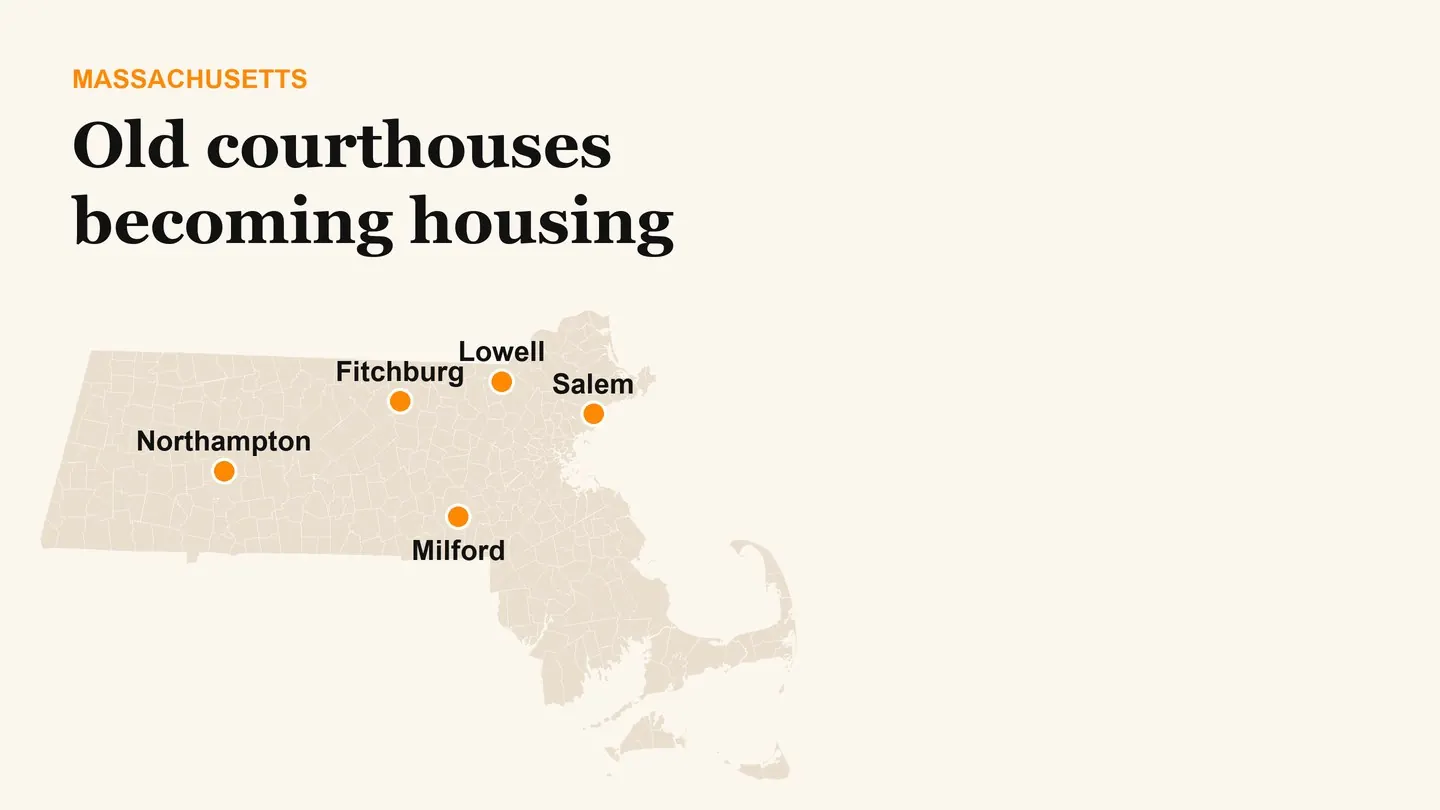
Former courthouse properties in Salem, Lowell, Fitchburg, Northampton and Milford are moving toward housing, helped by the state's push to reuse surplus public property. Banker & Tradesman reports plans ranging from 17 units in Fitchburg to 92 in Northampton. These are hard conversions because courthouses have huge courtrooms, wide halls, jail cells and few windows.
Massachusetts needs homes, and it has old courthouses sitting empty. Banker & Tradesman reported on October 25, 2026 that several are now headed for housing. The state's push to redevelop underused public land is a big reason why.
Here is what is planned, and what makes this kind of job difficult from a builder's point of view.
Which Massachusetts courthouses are becoming housing?
| Town | Property | Housing plan, as reported |
|---|---|---|
| Northampton | Former District Court, 33 King St. | 92 units. The city has a provisional agreement with Valley Community Development and Community Builders. |
| Salem | Superior Courthouse (1861) and County Commissioners' Building (about 1841) | WinnDevelopment has $48 million for 115 apartments in a new building on a nearby former parking lot, due in 2028. One plan makes the Commissioners' Building 14 studios. The courthouse's use is still open. |
| Lowell | Superior Courthouse (1835), over 65,000 sq ft | Sold at auction in June for about $1.9 million. Drafts show 36 or 50 units, with no final count. |
| Fitchburg | Former Superior Court, 84 Elm St. (1871) | 17 units, by the Tocci Group, after the state deeded it to the city. |
| Milford | District Court parking lots | The state plans to sell parts of the lots to housing developers. The court stays open. |
Why the state is selling courthouses
The courts moved into newer buildings over the past few decades, which left many older ones without a purpose. The Healey administration's State Land for Homes effort aims to turn empty or underused state property into housing, and the courthouse sales are part of that work.
Why a courthouse is so hard to convert into apartments
An architect quoted in the article ranks courthouses among the harder buildings to convert. That makes sense to me as a builder. An apartment layout is close to the opposite of a courthouse:
- Windows. Apartments depend on daylight, and bedrooms need a way out in a fire. Courtrooms and interior offices often sit far from an outside wall. See my guide to egress window requirements in Massachusetts.
- Odd rooms. Tall courtrooms, law libraries, cells and wide hallways don't divide neatly into kitchens and bedrooms.
- Exits. New units have to meet today's exit rules. I explain the basics in my post on the second means of egress.
- Old materials. The work in Salem includes hazardous-materials removal along with masonry, windows and an elevator. Buildings of this age call for testing before anyone opens a wall. See lead paint in older homes for the residential version.
- Historic rules. In Lowell, the higher unit count could put historic tax credits at risk. That shows the real trade-off: more apartments can mean less money to pay for them.
What this means for Greater Boston
A handful of courthouses won't solve the housing shortage. Together, these plans add up to a few hundred homes. But they show the state is willing to give up valuable buildings to get housing built. Closer to home, Somerville is having a similar debate over how large backyard cottages should be, and the state is also funding modular starter homes through Move-In Mass.
Own an older building?
I'm Mateus, a licensed builder working in Somerville, Cambridge and across Greater Boston. If you're weighing a conversion or major renovation of an older property, book a free walkthrough and I'll send a written line-item budget, usually within 48 hours.
Frequently asked questions
Which Massachusetts courthouses are being turned into housing?
Banker & Tradesman reported projects in Salem, Lowell, Fitchburg and Northampton. In Milford, the state plans to sell parts of the court's parking lots for housing while the court stays open.
Why are courthouses hard to convert to apartments?
They have large courtrooms, law libraries, wide hallways, jail cells, mazes of offices and few windows, so the layout doesn't fit apartments easily.
How much did the Lowell Superior Courthouse sell for?
It sold at auction in June 2026 for about $1.9 million, along with its parking lot, through the state's surplus land program.
What is State Land for Homes?
It is a Healey administration effort to turn abandoned or underused state property into housing.
Planning work near Somerville? See the towns I work in, with local permit notes, and how I price work.
Mateus Magno founded Magno & Co in 2020. He is a licensed Massachusetts Construction Supervisor (CS-123658), registered Home Improvement Contractor (HIC #220484) and certified Lead-Safe Renovator Supervisor who has renovated and managed over $5 million in projects across Greater Boston.
More about Mateus →