




Somerville property tax and the residential exemption: the dates, the numbers and what a renovation does to your bill
Somerville's residential exemption saved owners up to $4,578 in fiscal 2026. Who qualifies, the 2027 deadlines and what a renovation can do to your tax bill.
 Mateus Magno
Licensed Construction Supervisor · November 4, 2026 · 5 min read
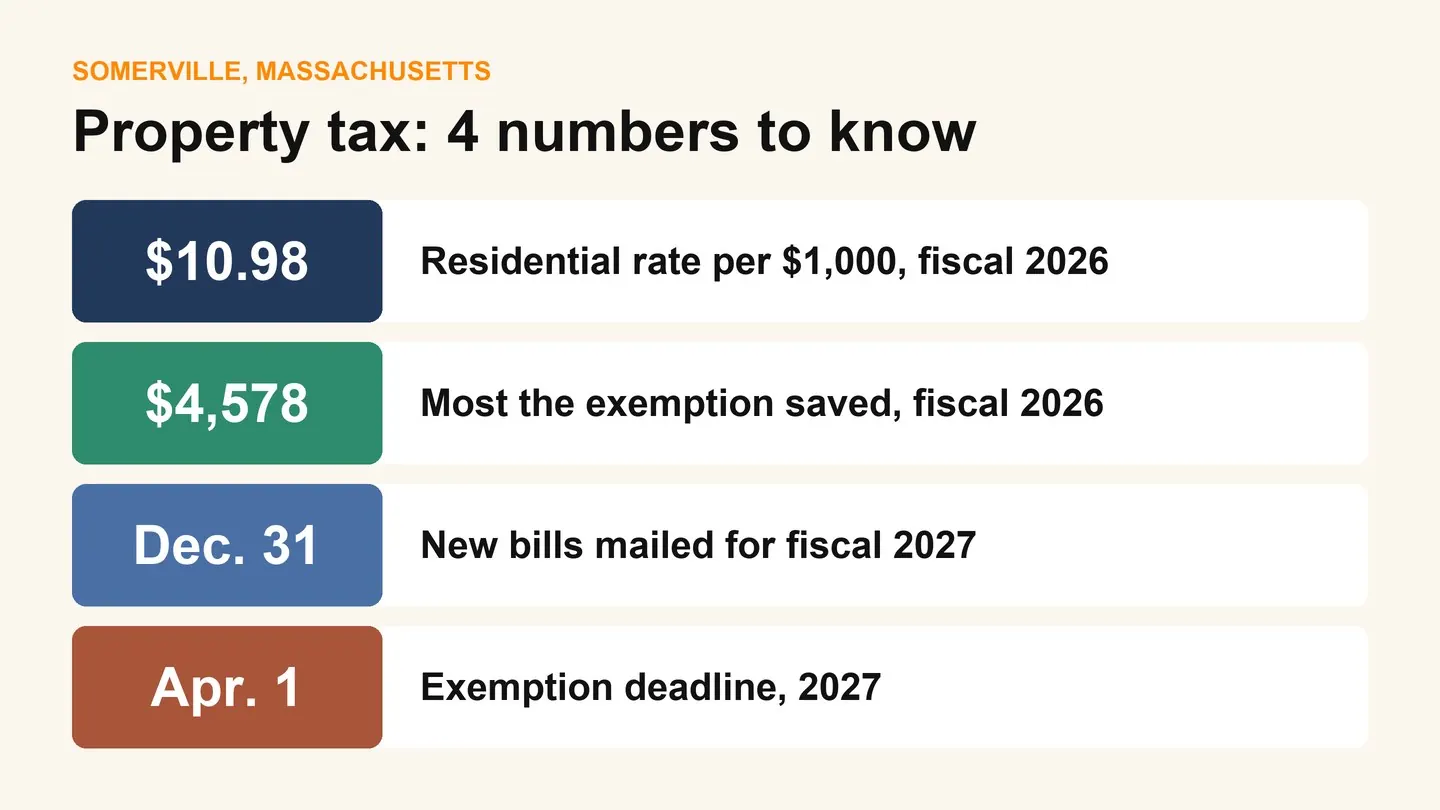
Somerville's fiscal 2026 residential tax rate is $10.98 per $1,000 of assessed value. Owners who live in their property as a principal residence can claim a residential exemption that saved up to $4,578, which the City calls the highest in Massachusetts. The fiscal 2027 rate and exemption aren't set yet. New bills go out about December 31, 2026, appeals are due February 1, 2027, and the exemption deadline is April 1, 2027.
If you own a home in Somerville, one form can matter more than almost anything else on your tax bill. Some owners miss it, especially in the first year or two after buying.
I'm a builder, so owners also ask me what a renovation will do to their taxes. Here's what the City publishes as of November 4, 2026. I'll update this post when the fiscal 2027 numbers come out. It's general information, so check your own situation with the Assessor's Office.
What is Somerville's property tax rate?
The fiscal 2027 rate isn't set yet. These are the latest numbers from the City's fiscal 2026 tax update, which showed the rates as pending state approval. A September 2026 comparison reports the same residential rate as certified.
| Item | Fiscal 2025 | Fiscal 2026 |
|---|---|---|
| Residential rate, per $1,000 | $10.91 | $10.98 |
| Commercial rate, per $1,000 | $18.92 | $18.94 |
| Residential exemption | 35% | 35% |
| Exemption savings | $4,328 | $4,578 |
How does the residential exemption work?
It doesn't take 35% off your bill. The City takes 35% of the average residential value in Somerville and subtracts that amount from your property's value before it figures the tax. In fiscal 2026, that worked out to about $417,000 of value by my math, or $4,578 in tax.
Here's how that looks on the City's average values. The last column is my rough math, and it leaves out the Community Preservation surcharge and anything else on your bill.
| Home type | Average value, fiscal 2026 | Average tax change from fiscal 2025 | Rough tax with the exemption |
|---|---|---|---|
| Condo | $775,675 | +$58 | $3,939 |
| Single-family | $1,187,364 | +$621 | $8,459 |
| Two-family | $1,193,941 | +$490 | $8,531 |
| Three-family | $1,474,682 | +$992 | $11,614 |
Who qualifies for the residential exemption?
For fiscal 2027, the Assessing Department's page says you must own and occupy the home as your principal residence on January 1, 2026.
- There's no income limit. The City offers it regardless of income.
- You usually don't refile every year. The Assessors do send notices from time to time asking owners to recertify, so don't ignore them.
- Owners who don't live there don't get it. If you're moving out or renting out a home you used to live in, tell the Assessor's Office.
- Recent buyers should check the date. If you moved in after January 1, 2026, you missed that date for fiscal 2027. Ask the Assessors when you can first apply.
The Mayor and City Council decide each year whether to adopt the exemption, typically at the end of December. The page says its status for fiscal 2027 is unknown until then, and the amount is still to be determined.
What are the key dates?
| Date | What happens |
|---|---|
| December 2026 | City decides the fiscal 2027 exemption, typically at the end of the month |
| December 31, 2026 | Third-quarter bills mailed with the new assessment and tax rate |
| February 1, 2027 | Third-quarter bill due, and last day to file an appeal (abatement) |
| April 1, 2027 | Last day to file for the residential and other exemptions |
The Assessor's Office is at City Hall, 93 Highland Ave., Room 108, at 617-625-6600 ext. 3100. If you plan to mail anything close to a deadline, call first and confirm the postmark rule.
Will a renovation raise my property taxes?
It can. Improvements can raise your assessed value, and Proposition 2½ doesn't cap the increase on a single property. That law limits the total the City collects, and value added by improvements counts as "new growth" outside that limit.
The Assessors review building permits and may inspect recently improved homes. Improvements are assessed as if they existed on the prior January 1, and the City says it can capture new growth up to June 30 before the fiscal year starts.
The City's own example is a two-family going from $400,000 to $600,000 after improvements. At the fiscal 2026 rate, that extra $200,000 would add about $2,196 a year by my math. Put simply:
- Each $100,000 added to your assessed value adds about $1,098 a year at $10.98.
- Your project cost isn't the added value. A $100,000 renovation doesn't automatically mean $100,000 more on the assessment. The Assessors decide that, and I can't predict it.
- The work that adds space or baths is more likely to show up. The City names condition, number of bathrooms and measurement changes as data that can change a value. That's why I'd include this in the budget for an added bathroom or a finished basement.
Please don't skip the permit to avoid this. Unpermitted work can cost you far more when you sell or get caught, and a permit protects you too.
How do I appeal my assessment?
File an abatement application with the Board of Assessors between the time the bill goes out and February 1, 2027. A few things to know:
- Keep paying. Filing doesn't stop collection, so pay on time to avoid interest.
- Expect up to three months. The Board has that long to decide. You can then appeal to the state Appellate Tax Board within three months of its notice.
- Allow the inspection. If you've filed an appeal and refuse an inspection, the Board has to disallow it. Assessors carry a City photo ID.
- Bring facts, not a hardship story. The value has to follow market data. The Mayor and your Councilor can't lower it for you either.
What other tax breaks does Somerville offer?
These are the fiscal 2027 figures on the Assessing page. Most use a July 1, 2026 qualifying date and require you to own and occupy the home, and the same April 1 deadline applies to the exemptions.
| Program | Who it's for | Amount |
|---|---|---|
| Clause 17D | Age 70+, surviving spouses and minors, with 5 years of ownership and occupancy | $353, plus 25% off water bills |
| Clause 41C | Age 65+, with income up to $28,378 single or $42,564 married, plus asset limits | $1,000, plus 25% off water bills |
| Clause 22 series | Veterans with a service-connected disability of 10% or more | From $411 up to 100%, depending on the clause |
| Clause 37A | Legally blind owners | $500 |
| Clause 41A deferral | Age 65+, with income up to $86,000 | Defer up to 100% at 2.5% interest, due at sale or transfer |
| Senior work-off | Over age 60, through the Council on Aging | Up to $1,500 credit |
Income-eligible seniors can also ask about an exemption from the Community Preservation surcharge. The state's Senior Circuit Breaker credit is a separate program through the Department of Revenue.
Planning work on your Somerville home?
I'm Mateus, a licensed builder based in Davis Square. I can't tell you what your assessment will be, but I can give you real numbers for the work. Book a free walkthrough and you'll get a written line-item budget, usually within 48 hours.
Frequently asked questions
What is the property tax rate in Somerville, MA?
The fiscal 2026 residential rate is $10.98 per $1,000 of assessed value, and the commercial rate is $18.94. The fiscal 2027 rate should appear on third-quarter bills mailed about December 31, 2026.
How much is the Somerville residential exemption?
In fiscal 2026 it was set at 35% of the average residential value and saved up to $4,578. The City calls it the highest in Massachusetts. The fiscal 2027 amount hasn't been decided yet.
What is the deadline for the Somerville residential exemption?
April 1, 2027 for fiscal 2027. You must have owned and occupied the home as your principal residence on January 1, 2026.
When is the Somerville property tax appeal deadline?
February 1, 2027 for fiscal 2027. Keep paying your bills on time while the appeal is pending.
Do renovations raise property taxes in Somerville?
They can. The Assessors review building permits and may inspect improved homes. At the fiscal 2026 rate, each $100,000 added to your assessed value adds about $1,098 a year.
Do I have to reapply for the Somerville residential exemption every year?
Usually not. The City says you don't need a new application each year, but it periodically sends notices asking owners to recertify. Tell the Assessors if you move.
Want a real number for your home? See my published prices and how I quote a job, and the towns I work in.
Mateus Magno founded Magno & Co in 2020. He is a licensed Massachusetts Construction Supervisor (CS-123658), registered Home Improvement Contractor (HIC #220484) and certified Lead-Safe Renovator Supervisor who has renovated and managed over $5 million in projects across Greater Boston.
More about Mateus →