Insulating Somerville and Cambridge's old homes: triple-deckers, flat roofs and empty walls
Somerville's median home dates to 1938. What 197 local insulation quotes show, and how to insulate triple-deckers, two-families and flat roofs the right way.
 Mateus Magno
Licensed Construction Supervisor · October 22, 2026 · 3 min read
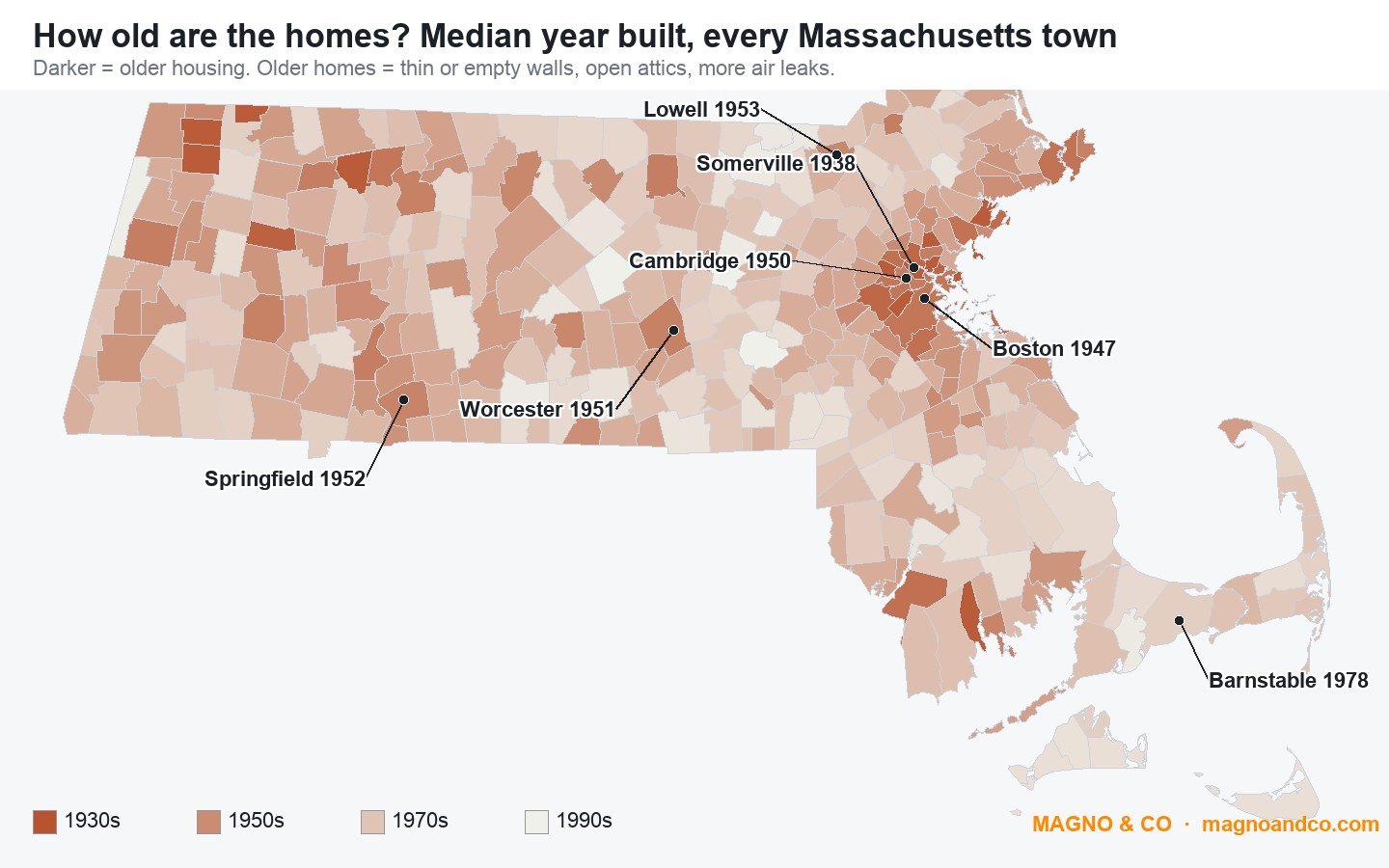
Somerville's median home was built in 1938 and Cambridge's in 1950. On my job map, Somerville had 115 insulation quotes and 52 installed jobs (median $4,750), and Cambridge had 82 quotes and 42 jobs (median $7,500). In these older homes, the best results usually come from air sealing first, then dense-pack cellulose in empty walls and low-slope roofs, then closed-cell foam at the basement rim joists.
Somerville and Cambridge have some of the oldest housing in Massachusetts. Walk down almost any street near Davis Square, Union Square or Inman Square and you'll see triple-deckers, two-families and mansard-roof singles built between 1880 and 1930. Most of them were built with no insulation in the walls at all.
That's why insulation is one of the most common upgrades I'm asked about here. Below is what the local numbers show, and how to insulate these houses without causing moisture or fire problems.
What the local job map shows
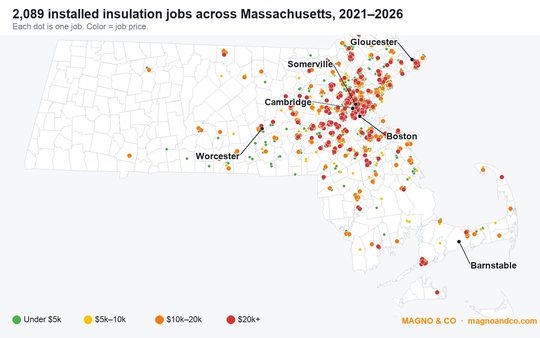
I built a job map of 4,543 insulation quotes from 2021–2026 for the insulation crews I work with, with all names and addresses removed. Here's the local slice:
| City | Quotes | Installed jobs | Median job | Median year built | Built before 1980 |
|---|---|---|---|---|---|
| Somerville | 115 | 52 | $4,750 | 1938 | 80% |
| Cambridge | 82 | 42 | $7,500 | 1950 | 68% |
| Boston | 411 | 176 | $5,500 | 1947 | 72% |
| Medford | 93 | 43 | $4,000 | 1942 | 76% |
| Newton | 235 | 118 | $8,025 | 1942 | 80% |
Year-built figures are from public Census housing data by town. Cambridge's higher median reflects more finished third floors, sloped ceilings and gut renovations. Somerville has many smaller attic and air-sealing jobs on multi-family houses.
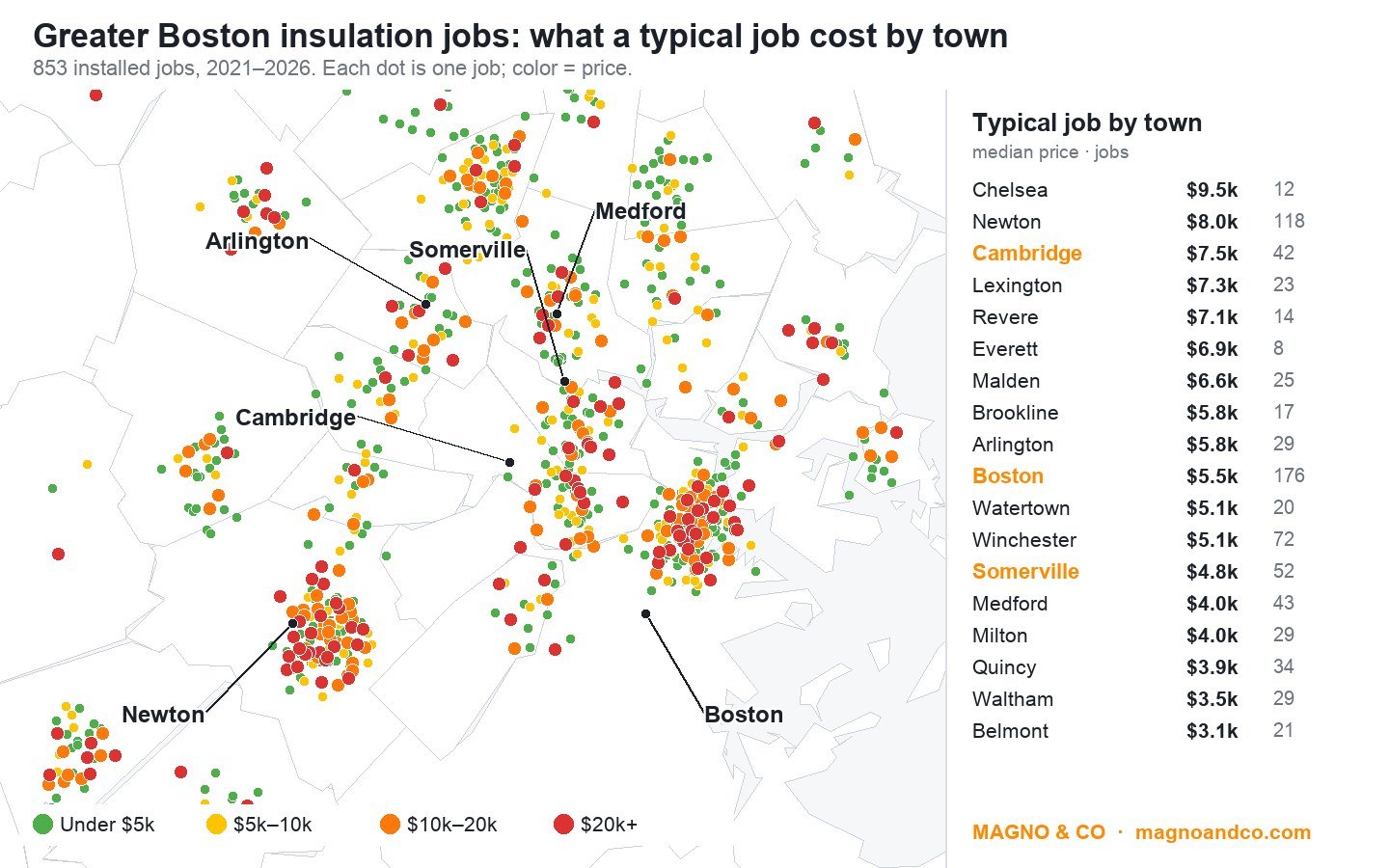
How Somerville triple-deckers lose heat
A classic Somerville or Cambridge triple-decker has three problems that work together:
- Empty walls. Most walls are just clapboard or shingles, sheathing, an air gap and plaster.
- Balloon framing. In many of these houses the wall studs run from the basement to the roof without stopping at each floor. Warm air rises inside the walls like a chimney and escapes at the top.
- Low-slope or flat roofs. Many triple-deckers have a nearly flat roof with a shallow, closed cavity instead of a walk-in attic. There's often no easy way in.
Add a leaky basement at the bottom and you get a strong "stack effect": cold air pulled in at the basement, warm air pushed out at the roof. The top-floor unit bakes in July and the first floor freezes in January.
The right order to insulate an older home
- Check for barriers first. Knob-and-tube wiring, vermiculite and bathroom fans venting into the attic or roof must be dealt with before insulating. See my guide to attic surprises.
- Air seal the top and bottom. Seal the top-floor ceiling penetrations, the tops of balloon-framed walls and the basement rim. This stops the chimney effect.
- Insulate the roof or attic. For a flat or low-slope roof, crews often dense-pack cellulose into the closed roof cavity. For a walk-in attic, blown-in insulation on the floor is usually best.
- Dense-pack the walls. Cellulose is blown through small holes into each wall bay, tightly packed so it won't settle. It also adds a lot of air sealing. Read how dense-pack works.
- Foam the basement rim joist. 2–3 inches of closed-cell spray foam where the house framing sits on the foundation stops a big draft.
Exterior work, historic districts and lead paint
Dense-packing from the outside means lifting a course of clapboards or shingles. In a Somerville local historic district you should check what exterior changes need review. Most houses built before 1978 have lead paint somewhere, so any work that disturbs painted surfaces must follow lead-safe rules. See my lead paint guide.
Don't forget Mass Save
Somerville and Cambridge homeowners can get most insulation work at a steep discount through Mass Save. Most customers can get 75% off approved insulation and air sealing, and income-eligible households can get it at no cost. Start with my Mass Save 2026 guide.
Local help in Somerville and Cambridge
I'm Mateus, a licensed builder based in Davis Square. Magno & Co insulates older homes in Somerville, Cambridge and across Greater Boston, from attics and flat roofs to walls and basements. Book a free walkthrough and I'll look at your house top to bottom and give you a written plan.
Frequently asked questions
How much does insulation cost in Somerville?
On my map of real jobs, the median installed insulation job in Somerville was $4,750 across 52 jobs from 2021 to 2026. Whole-house wall projects cost more than attic and air-sealing jobs.
Can you insulate the walls of an old Somerville house without removing plaster?
Yes. Dense-pack cellulose is blown through small holes, either from outside under a lifted clapboard or shingle course, or from inside. Each wall bay is filled tightly, and then the holes are patched.
How do you insulate a triple-decker flat roof?
Many triple-decker flat roofs have a shallow closed cavity. Crews often dense-pack cellulose into it through small openings after air sealing the top-floor ceiling. Ventilation and the roof's condition should be checked first.
Do I need my condo association's approval to insulate?
Usually yes. In most two- and three-family condos the walls and roof are common property, so the association should approve the work. Doing the whole building at once is cheaper and works better.
Mateus Magno is the founder of Magno & Co — a licensed Massachusetts Construction Supervisor (CS-123658), registered Home Improvement Contractor (HIC #220484) and certified Lead-Safe Renovator Supervisor who has renovated and managed over $3 million in projects across Greater Boston.
More about Mateus →